I started learning 3D software sometime in 2014. I was living in Alaska and working for KTVA 11 in the production department when I was selected–along with my friend who headed up the graphics department–to attend trainings with a Maxon certified instructor who guided us through Cinema 4D. What a freaking undertaking. 3D was unlike anything I had ever seen before. It had a whole new set of rules and considerations I had never run into as a graphic designer or video editor, but it was also magical. It was this entire realm of creative outlet that I had never seen before and it gave me a whole new appreciation for what went into it.
So, after I’d left that crash course I set out to learn 3D on my own. A few (hundred) tutorials, an associate’s degree in computer animation, and a full 7 years later have led to this moment. I wish I could say in that time that I had achieved a good chunk of my 10,000 hours, but I did not. I don’t have an excuse for it. I chose to continue pursuing my career in video production and use my 3D knowledge when it was useful for that. It has indeed proved to be useful. It was crucial in landing me a job at ODOT which came after being laid off when my previous employer gutted the video department. It was also a contributing factor to getting my current job in the state of Washington. Both times having 3D as a back pocket skill fleshed out my resume and kept me competitive for key gigs in my career.
So that brings us to the present. A friend of mine puts me in contact with some people heading the Extra Life charity drive for a game shop in Oklahoma called Game HQ. It turns out they are looking for a 3D artist who can put some unique touches on a base model figurine they plan to have printed, painted and given away as part of their Extra Life event. They had a model from a previous year which was a simple design meant to stand on its own and display the Extra Life logo.

It worked well enough, but they wanted something more unique for this year and years ahead. So, they enlisted me for help. I love Extra Life. I’ve participated in the event several times over the last 8 years and intend to partake in this year’s event, as well. So, I really liked the idea of contributing to another campaign beyond a simple donation. Plus, I’d actually worked with these folks the year before. I offered my assistance as a virtual DM for their game day event and we streamed a D&D module to generate donations from viewers. We shot a couple messages back and forth and got to work.
The project officially started about a week into September with a deadline of October 31. That’s not that daunting on its own, but I still consider myself an amateur when it comes to modeling something from scratch. Follow that up with the fact that I am working a full-time job and the clients aren’t really sure what to detail in a commission like this, we’ve got ourselves a recipe for a complicated sprint.
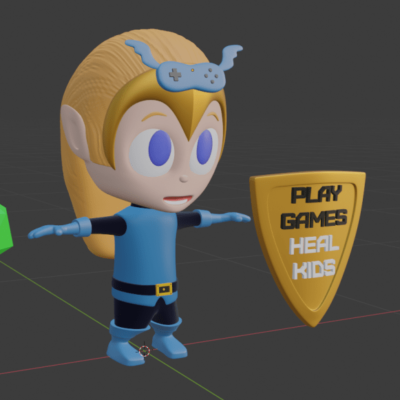
At the end of September, we got a good reference image in the form of the t-shirt design for the same campaign. I took it on myself to not simply update the base model they had used previously, but build a new model from scratch incorporating the new character design for the shirt. The sprint just got a little harder as now I’ve taken the project from a simple figurine with add-ons to a fully unique character design.

There is some good news, though. We know the character is going to be super-deformed or chibi in style. So, I can work on the base model out of the gate and add elements as we go along. My first take is… something.


Don’t get me wrong. I was rather proud of my “if Slenderman was a baby” clay model. For being my first real character with arms and legs, I felt it was solid enough. I even managed to create and attach hands which was a feat in and of itself. Still, looking back I do see a lot of issues. I have holding edges all over the place which create these odd sharp angles on the character. Most notably in the neck which looks like a melted cube instead of an organic oval. The proportions are also all wrong, even by chibi standards. I could have push the shape so much more than this and given it more organic curves instead of rigid extrusions. Needless to say, they weren’t immediately thrilled. This failure was a great opportunity, though. Now that they had something to critique and we could hone our direction.
Cue my second attempt from the same day which incorporated their feedback and used a different reference image to boot.


This one was much better. I decided to shift the weight of the body down. Keeping in mind that this figurine was meant to be printed and set as a desktop piece, I wanted to design it with balance in mind. By widening the stance and giving the feet more of a base, we could now have the model stand more on its own. I left the arms and hands small intentionally since the final character would be wearing armor and gloves so I was relying on that to thicken the model. They were much happier with this start and I was given the green light to run with it.
The complications came when work required a lot more from me. I didn’t have to put in extra hours or anything, but I was being drained from some tight deadlines and additional responsibilities. I felt like a wrung out rag and I still needed to focus on building the 3D character to make the deadline. It was a lot to take on, but I also was enjoying myself. Even when it was overwhelming, I still thrived in 3D space. I enjoyed working on it late at night while listening to music and letting YouTube play me videos. It was exhaustive, but it was fulfilling.
It’s October 23, about a week before the figurine needs to be finalized and printed. I’ve reworked a lot of the model and built out the clothing, armor and weapons as best I can. My plan is to fully build the model in t-pose, rig it and pose it to it’s final form. I’m at the point where I am ready to rig and pose it, but I want final confirmation that the design is approved before I start that process–another process I have never done before.


I’m proud of almost everything but the hair. I had a way I wanted to model the hair, but I scrapped it for something easier and I did not like it. So, I sent these off with a note detailing how my plan was to revamp the hair when I worked on the actual pose. Since I knew this would be a 3D print, I wanted to meld the hair with the body to create a more simple overhang. Hopefully cutting down on the overall supports needed for the print process.
They liked the direction of the model but made a note to close the mouth and have a simple smile for the character which worked well for me since I had never posed an open mouth before. So I got to work on the updates and worked the next few days on rigging and posing the character.
I remember once in a 3D modeling course the instructor explaining that rigging was the most thankless, difficult and tedious job in the industry, and if you wanted to have insane job security to just get good at rigging because it’s one of the more needed job in the field. I learned firsthand why. Now, I have to stress that during this process, I did not remesh the character, nor did I bother with any sort of weight painting. I was concerned for time and wanted simple to get a simple rig for the model so that I could generally pose it and send it along to get notes for the pose before finalizing it. Due to this, the mesh breaks. The fingers do not work at all and the body stretches and facets the second I attempt to deform it. I am met with two options: 1) I can rework the model and learn proper topology for deformation or 2) I could go with what I have and remesh the body later.
I choose to go with the latter. I think if this was a character I intended to animate or create multiple poses for that I would have reworked everything from scratch, but with the time constraints–at this point it was the 28th and I had only 3 days to complete the model and get it ready for the print–and the use case, I wanted to move forward. So, I quickly posed and sent the screenshots on for review and approval.


I did remake the hands and manually posed them. Both hands needed to be fists so rather than creating a neutral hand and balling it into a fist, I just modeled the hand in the fist pose. I don’t think that is usually how character design should be done, but I wanted to make it simpler as a standalone piece. I also reworked the hair for this pose and used a different method that gave me a lot more control without the strange topology of the previous version. Whereas before I modeled on top of the scalp and used a solidify modifier, this time I modeled on top of the scalp and extruded the faces to create thickness in the hair. I also covered more of the head and tapered the hair to fit everything appropriately without intersecting the ears or anything.
The client was happy and asked me to add any small details I thought would be beneficial to sell the fantasy armor aspect of the model. Up to this point I was adding everything I wanted. I was trying to keep the model as true to form as the t-shirt design which I thought was excellent, but I also understood the purpose of making the figurine more visually engaging.
For the arms and the pants and the boots, I did not need to remesh anything. The deformation was slight and I wound up just adjusting individual vertices to cut down any faceting. The body was a little different because it had that twist to it. I decided the easiest way to make the body flow would be to remesh it by building on top of what was already there. So, I cut out to do just that. It was a simple enough process and I think the results speak for themselves. After it was successful, I am convinced this was the right way to approach this situation given the deadline.


I also finished up the hair and added some details suggested by my life partner. She helped me with the belt add-ons and I added the dice like in the t-shirt design. Per request from the client, I also added the wrapping and the thong on the weapon–which I had avoided to this point since it was a significant overhang for the print.
I got my final approval from the client and set out to make the file print ready. Which was a rather cumbersome process. I built the model in pieces and had to marry everything together for the print file. Now, I dabble in 3D printing, so I knew I needed to avoid any intersecting faces, holes, hollow sections of the model, etc. So, putting everything together was a considerable challenge. I used booleans for the large version of the model and was able to get it mostly good to go, but still had to go in afterward and clean up areas where the boolean was not friendly. I rarely use any sort of cleanup tools in 3D programs as I more prefer to go in and manually fix things, but 3D printing is different. A slicer will triangulate a models faces automatically, so I have the capacity to triangulate any wonky faces in Blender to make the transition from program to program much more simple.
It took me several hours, but I finally managed to get a large version and a miniature version of the print files to not return errors in the Photon Workshop and Cura print slicer software. So, at 3:30 am on Sunday morning, I was wrapped and the project successful.
…Well, that would have been a fine way to end this post, but in actuality, I was contacted by the person printing the files and he expressed that he was getting errors from his 3D printing software Lychee. There were holes somewhere in the model and it was returning that there were 50+ areas that might print incorrectly. Furthermore, the size was molecular for some reason. He had to scale the model up 10,000% so get it to be visible on the virtual print bed. So, it was back to the grindstone again as I set out to get that all fixed up.
By this point, I am exhausted. I have downloaded and installed Lychee and I am getting similar errors to the person printing the piece. Today is the last day I have to make this file right, so I am worried I won’t get it done in time. I could spend the next several days remeshing it by hand to insure there is nothing I am missing, but I think that is out of the question given that we’re officially at the day of the deadline. So, I take the full models into ZBrush and painfully click Dynamesh to create a solid model to work from. I weld any caps or points I can find and fix up any odd points in the model where it doesn’t quite come together cleanly. And this works. I am able to take the file into all 3 printer slicer programs and it shows up at the right size without the errors.

Left is the remeshed version, right is the original model.

Left is the remeshed version, right is the original model.
I am not that unhappy with the remeshed version of the model aside from the fact that I even needed to do this in the first place. In a perfect world, I would have sent off the model and it would have worked out, but this was an incredible learning opportunity for me. I now have a slicer program that has a way lower tolerance for errors where I can check my models for print and I learned how to properly export 3D models from Blender for proper sizing in a slicer program. I learned a heck of a lot about what booleans will cause issues and how to clean them up or avoid them entirely–especially for smaller parts. Overall I learned how to better model for 3D printing and what to keep in mind for the future.
This project was amazing to be a part of and I learned an outrageous amount about what I am capable of when it comes to 3D modelling, time management and 3D printing. It was exhausting and discouraging and frustrating at times, but I would do it all again–just hopefully without as many hiccups this time around. I believe the adversity of an undertaking like this is what helps us to grow in production no matter the field. So, I feel steeled for any other 3D projects that may come my way. Now that I know I can do something like this, I am more ready and excited than I have been since I took that crash course many years ago.